 By dispatcheradmin
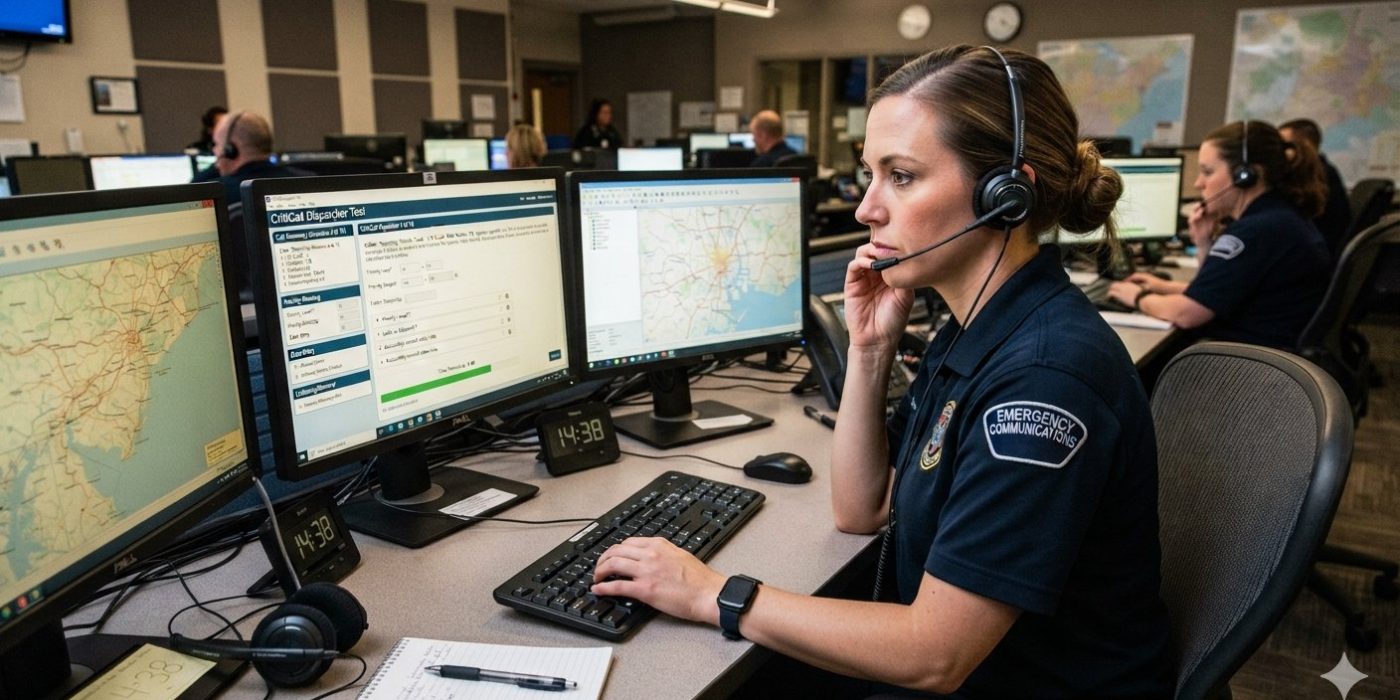
If you are applying for a 911 dispatcher or public safety telecommunicator job, you may have already come across something called the CritiCall test or CritiCall exam.
For someone taking a 911 dispatcher test for the first time, the name alone can sound complicated. You may start wondering what questions will be asked, whether you need previous dispatching experience, how difficult the test is, and whether you can find a CritiCall practice test free online.
The good news is that the CritiCall assessment is not designed around memorizing hundreds of police codes or learning everything about emergency dispatch before you apply. Instead, it focuses on skills that can be important in a dispatch environment, including multitasking, data entry, listening, memory, decision-making, prioritization, and other abilities.
The exact assessment can also vary between agencies because different agencies can select different tests for their hiring process.
So if you’re preparing for a 911 dispatcher job, understanding what the CritiCall test is—and what it is not—can make your preparation much easier.
What Is the CritiCall Test?
The CritiCall test is a pre-employment assessment used by public safety agencies to evaluate applicants for positions such as 911 dispatcher, calltaker, and public safety telecommunicator.
It is different from a traditional written exam.
Instead of simply answering questions about information you have memorized, the assessment can place you in situations that require you to use skills similar to those needed in a dispatch environment.
For example, an assessment may require you to enter information from a written or spoken source, remember details, prioritize information, or work on more than one task at a time.
The CritiCall test library includes assessments covering areas such as computerized data entry, call summarization, keyboarding, memory, map reading, decision-making, proofreading, spelling, and multitasking.
The current CritiCall 3D system also includes operational, situational, and behavioral components.
Why Is the CritiCall Test Important?
Working in emergency communications requires more than simply being able to answer a telephone.
A dispatcher may need to listen carefully while entering information into a computer, remember important details, make decisions, and keep track of changing information.
That is why a 911 dispatcher practice test that focuses on these underlying skills can be more useful than simply studying a list of random dispatcher questions.
CritiCall is intended to measure abilities that can be relevant before an applicant receives job-specific training. The candidate preparation guide states that applicants do not need specialized dispatcher knowledge or training to understand or answer the test items.
In other words, you don’t need to become a professional dispatcher before you take the test.
You need to prepare yourself to demonstrate the skills the assessment is designed to measure.
What Is Included in a CritiCall Exam?
The exact sections depend on the hiring agency, so don’t assume every applicant will receive the same CritiCall exam.
Some of the areas that may be included are:
Data Entry
You may receive information in written or spoken form and need to enter it correctly using a keyboard.
This can test both speed and accuracy.
For a dispatcher, entering the wrong number, address, or other important information can create problems. That’s why accuracy should not be ignored while you’re trying to improve your typing speed.
Call Summarization
Some CritiCall assessments involve listening to spoken information and identifying the important details.
This isn’t simply about hearing every word.
You may need to separate useful information from unnecessary details and enter or summarize the information accurately.
Multitasking
Multitasking is another important part of many dispatcher assessments.
You may need to respond to information while simultaneously performing another task.
This is one of the reasons a 911 dispatcher test can feel different from an ordinary employment exam.
Memory
Some tests measure your ability to remember written or spoken information.
The information may include numbers, letters, names, or other details.
You don’t need a photographic memory. What matters is being able to pay attention and retain useful information.
Decision-Making and Prioritization
Dispatchers regularly deal with information that needs to be organized and prioritized.
CritiCall includes assessments related to decision-making and prioritization.
Map Reading
Depending on the assessment selected by the agency, you may also encounter map-reading or geographic-direction tasks.
These can involve identifying locations or determining the appropriate route based on the information provided.
Keyboarding
Keyboarding can also be tested separately.
The CritiCall test library describes keyboarding assessments in which applicants enter written material using a keyboard, with the score based on typing speed.
That makes regular typing practice useful even before you know exactly which sections your agency will use.
Is There a CritiCall Practice Test?
This is one of the most common questions applicants ask.
The official CritiCall website says that the actual CritiCall software is not provided to applicants as a general practice test. The software is provided to emergency response agencies and verified private dispatch companies.
However, CritiCall does provide applicant preparation resources and free sample tests for certain skills, including keyboarding, proofreading, and spelling.
So when you search for a CritiCall practice test, be careful about websites claiming that they have the exact current CritiCall exam.
A practice test can help you improve the skills involved, but that doesn’t mean it contains the actual assessment your agency will give you.
Can You Find a CritiCall Practice Test Free?
Yes, there are free applicant resources available, but there is an important distinction.
The official CritiCall applicant resources include sample tests for specific skills rather than giving applicants the complete proprietary assessment.
You can also practice many of the underlying skills without paying for special software.
For example, you can work on:
- Typing speed
- Typing accuracy
- Data entry
- Reading comprehension
- Listening
- Memory
- Basic map reading
- Proofreading
- Multitasking
- Decision-making
This is actually a useful approach because your agency may not use every available CritiCall module.
How to Prepare for the CritiCall Test
You don’t need to spend hours memorizing complicated material.
Start with the skills.
1. Improve Your Typing
Practice typing every day, even if it’s only for 10 or 15 minutes.
Pay attention to both speed and mistakes.
Getting 60 words per minute isn’t particularly useful if you make a large number of errors.
If you’re preparing for a 911 dispatcher position, accurate keyboarding is a practical skill worth developing.
2. Practice Data Entry
Create a simple list of names, addresses, phone numbers, dates, and other information.
Then practice entering that information into a document or spreadsheet.
Try to become comfortable looking at information, entering it, and checking it without losing your place.
3. Practice Listening
Ask someone to read a short paragraph or list of information to you.
Write down the important details while they are speaking.
Then compare your notes with what was actually said.
As you improve, gradually make the exercise faster.
4. Work on Multitasking
You can practice multitasking without expensive software.
For example, listen to information while entering numbers into a document.
The goal isn’t to do as many things as possible.
The goal is to remain accurate while dealing with more than one source of information.
5. Practice Reading Carefully
Don’t rush through instructions.
A simple question can become difficult if you misunderstand what it is asking.
Read the entire instruction, identify what information matters, and then respond.
6. Work on Memory
Have someone read a list of numbers, names, or short facts to you.
After a short delay, try to recall them.
You can gradually increase the number of details.
This is a simple way to exercise your ability to listen and retain information.
Is the CritiCall Test Hard?
That depends on the person.
Someone who types quickly may struggle with memory or multitasking. Another applicant may have excellent attention to detail but need more practice with keyboarding.
The test can also vary depending on what the hiring agency has selected.
So instead of asking, “Is the CritiCall test hard?” a better question is:
Which skills do I need to improve before test day?
That gives you something useful to work on.
What About a 911 Dispatcher Practice Test Free Online?
You can find many free dispatcher practice resources online, but don’t assume every website is using real CritiCall questions.
A good practice resource should help you improve a skill.
For example, a typing exercise can help you improve keyboarding. A data-entry exercise can improve accuracy. A memory exercise can help you practice retaining information.
That is much more useful than memorizing a collection of supposed “real CritiCall questions.”
The official provider itself warns that the actual CritiCall software and test details are not provided to applicants.
What Should You Do on Test Day?
When the day of your CritiCall exam arrives, don’t make things harder than they need to be.
Read the instructions carefully.
Use any practice items provided before a section. According to the official preparation guide, practice items may appear at the beginning of test sections and are not included in the final score.
Don’t panic if one section feels difficult.
Move forward and concentrate on the task in front of you.
And don’t assume that working as fast as possible is always the answer. In many areas, accuracy matters just as much as speed.
Common Mistakes When Preparing for the CritiCall Test
Here are some mistakes worth avoiding:
- Practicing only typing
- Ignoring accuracy
- Trying to memorize supposed real test questions
- Waiting until the night before the exam
- Assuming every agency uses the same CritiCall assessment
- Spending money on questionable “exact test” packages
- Ignoring the instructions from your hiring agency
- Getting discouraged after one difficult section
Preparation should make you more comfortable with the skills—not make you obsessed with predicting every question.
Frequently Asked Questions
What is the CritiCall test?
The CritiCall test is a pre-employment assessment used by some public safety agencies to evaluate skills relevant to dispatcher and calltaker positions.
Is there a free CritiCall practice test?
CritiCall provides free applicant resources and sample tests for certain skills, but it does not provide applicants with the complete actual CritiCall software as a general practice test.
What is included in the CritiCall exam?
Depending on the agency, the assessment can include areas such as data entry, multitasking, call summarization, memory, keyboarding, decision-making, proofreading, spelling, and map reading.
Do I need dispatcher experience before taking the CritiCall test?
No specialized dispatcher knowledge is generally required to understand the assessment. The candidate preparation guide explains that the test measures underlying skills and abilities rather than requiring specialized dispatcher training.
Is the CritiCall test the same for every 911 dispatcher?
No. Agencies can select different tests or modules depending on their hiring needs.
How can I prepare for a 911 dispatcher test?
Work on typing accuracy, data entry, listening, memory, reading comprehension, multitasking, decision-making, and prioritization. Also follow any preparation instructions provided directly by the agency you are applying to.
Final Thoughts
Preparing for a CritiCall test doesn’t have to mean trying to memorize hundreds of questions.
Focus on the skills instead.
Practice typing. Work on accurate data entry. Improve your listening and memory. Get comfortable handling more than one task at a time. Most importantly, learn to stay accurate when you’re under a little pressure.
If you’re searching for a CritiCall practice test, CritiCall practice test free, or a 911 dispatcher practice test, remember that the goal should be to improve your abilities—not simply memorize answers that may never appear on your exam.
The exact assessment depends on the agency, so always check the instructions you receive from the department you’re applying to.
And if you’re serious about becoming a 911 dispatcher, the skills you develop while preparing for the CritiCall exam can continue to help you long after the hiring test is over.