 By dispatcheradmin
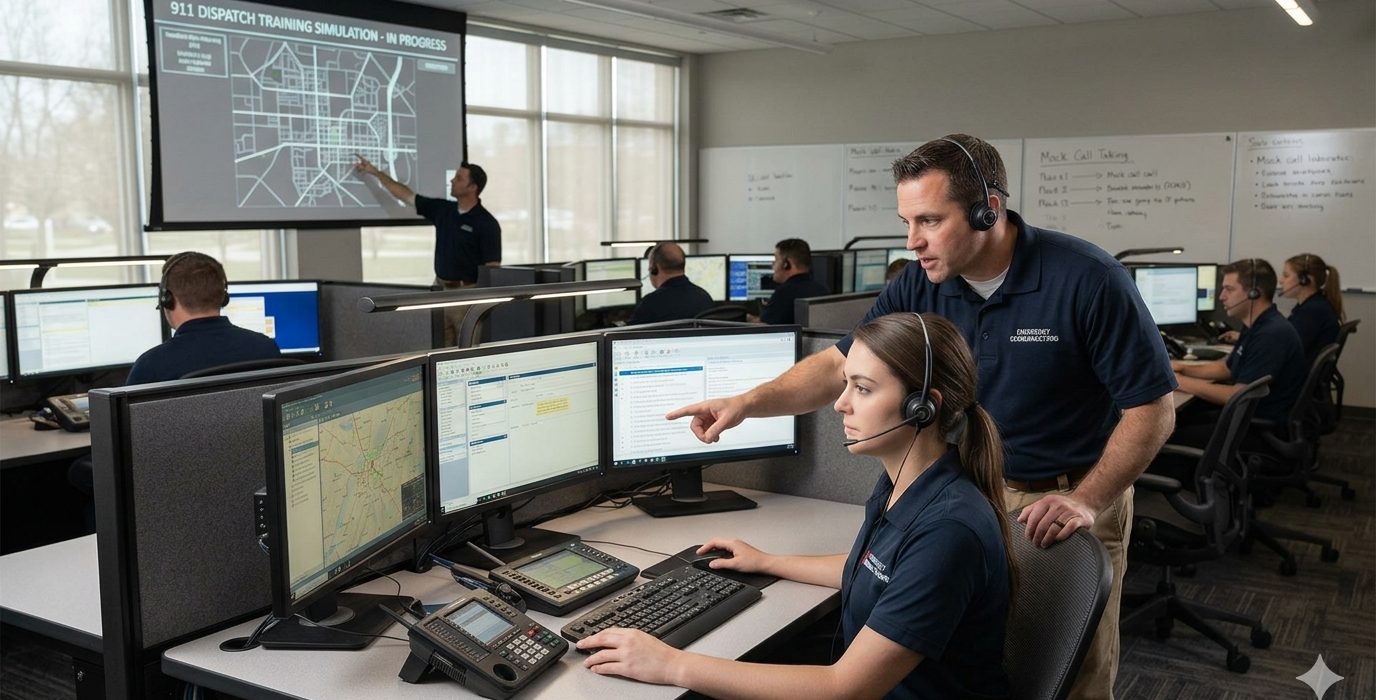
Becoming a 911 dispatcher involves much more than answering emergency and non-emergency calls. Dispatchers learn how to gather critical information, use specialized communication systems, follow established procedures, communicate with police, fire, and EMS responders, and remain focused during stressful situations.
911 dispatcher training prepares new public safety telecommunicators for these responsibilities. Training can include classroom instruction, computer-based learning, practical exercises, supervised call taking, and on-the-job training.
Training requirements vary across the United States. States, counties, cities, and individual 911 centers may have different education, certification, and training requirements. The National 911 Program provides recommended minimum training guidelines, but these guidelines are not federal training requirements.
In this guide, you’ll learn what 911 dispatcher training covers, how long training can take, what certifications may be required, what happens during on-the-job training, and what new dispatchers can expect when starting the job.
In this guide, we’ll explain in details, what 911 dispatcher training usually includes, how training is delivered, how long it can take, and what new dispatchers should expect.
What Is 911 Dispatcher Training?
911 dispatcher training is the education and practical preparation that teaches new public safety telecommunicators as we called 911 Dispatchers, how to perform their job safely and effectively.
Depending on the agency, A dispatcher may be trained in:
Emergency and non emergency cals handling
Call taking procedures
Radio and Wireless communications
Computer-aided dispatch (CAD) systems
Emergency communication technology
Local Mapping and geography
Police, fire, and EMS procedures
Legal and privacy requirement
Crisis communication
Stress and workload management
Documentation and record keeping
Emergency medical dispatch procedures
Working with different types of callers
The training may include Control room instruction, computer based learning, practical exercises, supervised work, and on the job training.
The U.S. Bureau of Labor Statistics says public safety telecommunicators typically receive moderate term on the job training, while the exact requirements is different by state and locality.
Is 911 Dispatcher Training Required?
In practice and ideally, new 911 dispatchers should expect training after being hired.
However, there is no single nationwide training requirement or training program that applies identically to every 911 dispatcher in the United States.
BLS reports that many states and localities require public safety telecommunicators to become certified, while training requirements and training length may be differant. Some states require a specific number of training hours, while some agencies establish their own program.
This means you should always check the requirements/ training of the specific agency where you want to work.
How to Become a 911 Dispatcher
The process of becoming a 911 dispatcher varies by state and agency, but the general path usually includes several steps.
1. Check the Basic Requirements
Start by checking the requirements for the agency where you want to work. Many agencies require a high school diploma or equivalent, while some may have additional requirements.
2. Apply for a Dispatcher Position
Search for public safety telecommunicator, 911 dispatcher, emergency dispatcher, or 911 call taker positions with local agencies. Carefully review the job announcement because requirements can vary.
3. Complete the Hiring Process
Depending on the agency, the hiring process may include an application, written or computer-based testing, interviews, background checks, and other assessments.
4. Complete Initial Training
After being hired, new dispatchers typically complete agency-specific training. This may include classroom instruction, computer training, communication procedures, emergency protocols, and other required subjects.
5. Complete On the Job Training
New dispatchers commonly receive supervised on-the-job training. During this stage, trainees gradually take on real responsibilities while working with experienced trainers.
6. Meet Certification Requirements
Some states and agencies require specific certifications or training hours. Others provide certification or qualification through their own training programs.
7. Continue Learning
Training does not necessarily end after a dispatcher becomes independent. Agencies may require continuing education, refresher training, and additional certifications throughout a dispatcher’s career.
What Do You Learn in 911 Dispatcher Training?
Training covers much more than simply answering a telephone.
1. Calls Handling and Processing
One of the first skills a dispatcher must develop is the ability to handle emergency and non emergency calls effectively.
Training teaches dispatchers how to:
Answer all calls professionally
Clear Identify the location of an emergency
Determine what exactly happened
Ask appropriate and to the point questions
Identify immediate Risk
Gather whole information
Enter information into the dispatch computer system
Memorize what happened
Follow agency procedures
The dispatcher needs to collect useful information while keeping the caller calm, cool and focused.
This can be difficult when callers are in hurry, frightened, angry, confused, injured, drained or unable to open and clear communicate.
2. Communication Skills
Communication skills is one of the most important parts of dispatcher training.
Dispatchers communicate with:
Emergency callers
Non emergency callers
Police officers
Firefighters
Emergency medical personnel
Other dispatchers
Supervisors
Other public safety agencies
Training can include active listening, clear questioning, professional communication, problem solving, leading the situation and communication with people who have different needs and behaviour.
The National 911 Program’s recommended training guidelines include interpersonal communication, critical thinking, customer service, and communication with non native language and communications impaired callers.
3. Emergency Communications Technology
Modern dispatch centers and control rooms use specialized technology.
Training can introduce new dispatchers to systems such as:
911 Networking and telephone systems
Computer aided dispatch (CAD)
Radioand wireless systems
Mapping systems
Location information
Emergency databases
Calls Recording systems
Other communication center technology
The National 911 Program training framework includes emergency communications technology such as basic 911, Enhanced 911, Mapping and location information, wireless 911, and Advance 911 concepts.
The exact systems depend on the agency.
4. Computer Aided Dispatch (CAD)
CAD is an important part of many modern dispatch and control room centers.
A CAD system can help dispatchers create and manage incident or emergency records, provide information about any type of calls, display locations, and support communication between dispatchers and emergency responding units.
New employees generally receive training on the specific CAD system used by their agency.
You do not necessarily need to know a particular CAD system before applying. The agency will normally teach you how to use its own equipment and software.
5. Radio and Wireless Communications
Dispatchers often communicate with police, fire, EMS, or other responders using radio and wireless systems attached to their Vehicles.
Training may cover:
Radio and wireless procedures
Radio and wireless terminology
Channel selection
Dispatch procedures
Communicating with multiple units
Prioritizing radio and wireless traffic
Maintaining accurate information
The goal is to communicate information clearly and efficiently so responders know what is happening and where they need to go.
6. Local Mapping Geography
Knowing the local area is extremely critical important.
A dispatcher may need to understand:
Streets
Highways
Intersections
Shoping Malls
Buildings
Neighborhoods
Public and Private Park facilities
Geographic boundaries
Police and fire jurisdictions
Training may include maps, computer mapping systems, Drill exercises, and practical experience.
You don’t need to memorize an entire city before starting the job. Geography is normally learned as part of agency training and daily experience.
7. Police, Fire, and EMS Procedures
Depending on the dispatch center, you may handle calls involving police, fire, EMS, or any other.
Training helps dispatchers understand how different emergency services respond to incidents.
For example, a dispatcher may need to understand the basic process for calls involving:
RTAs and Vehicle crashes
Fires
Medical emergencies
Domestic incidents
Missing persons
Drowning and Flood
Suspicious activity
Hazardous situations
Public safety threats
The exact procedures depend on the agency.
8. Legal and Privacy Issues
Dispatchers deal with sensitive and private information, so legal and ethical responsibilities are an important part of training.
Training can include topics such as
Confidentiality
Privacy
Documentation
Records
Liability
Agency policies
Legal responsibilities
Appropriate use of information
The National 911 Program’s training framework specifically includes legal concepts, confidentiality, documentation, records, and privacy-related topics.
9. Emergency Medical Dispatch
Some dispatch centers train telecommunicators to provide specific medical instructions over the telephone before emergency responders arrive.
Emergency Medical Dispatch (EMD) training can teach dispatchers how to identify and prioritize medical emergencies and provide approved pre arrival instructions.
For example, a dispatcher may need to guide a caller through an emergency procedure while an ambulance is on the way.
The exact EMD program depends on the agency. APCO International, for example, offers an EMD program based on national standards and provides training for telecommunicators who handle emergency medical calls.
10. Stress Management and Wellness
911 dispatchers regularly deal with stressful situations.
Training may therefore include information about:
Managing stress
Maintaining concentration
Healthy coping strategies
Professional wellness
Recognizing the effects of difficult calls
The National 911 Program includes health and wellness among the recommended training areas, and 911.gov notes that dispatcher training can include ways to manage stress and stay healthy on the job.
How Long Does 911 Dispatcher Training Take?
There is no single training length for every 911 dispatcher.
The amount of training depends on the state, agency, job responsibilities, and certification requirements.
According to BLS, some states require 40 or more hours of training, while other states and localities have different requirements. Some agencies also require continuing education. BLS notes that training can include classroom instruction, demonstrations, and a probationary period that may last about a year, although this varies by agency.
So it is better to think of dispatcher training as a process rather than one short course.
A typical path might look something like:
Hiring → Initial training → Testing/evaluation → On the job training → Supervised dispatching → Independent work
The exact sequence can be different from one agency to another.
What Are the 2026 National 911 Training Guidelines?
In June 2026, the National 911 Program updated its Recommended Minimum Guidelines for Initial Public Safety Telecommunicator Training.
The guidelines were developed through a collaborative process involving the 911 community. They establish a baseline of topics that can be included in telecommunicator training programs.
Importantly, these are recommended guidelines, not federal training requirements. State and local requirements can be different.
The updated guidelines address areas such as:
Roles and responsibilities
Legal concepts
Interpersonal communication
Emergency communications technology
Call processing
Radio communications
Emergency management
Stress and wellness
Quality assurance and improvement
Other public safety communication competencies
NENA also describes the updated guidelines as a foundation for training aspiring and current 911 telecommunicators.
Do You Need a College Degree for Dispatcher Training?
Generally, no.
BLS states that public safety telecommunicators typically need only a high school diploma or equivalent for entry into the occupation. Training is then provided on the job, although requirements vary by location.
Some agencies may have additional education, testing, certification, or experience requirements.
Always read the job announcement carefully before applying.
Do You Need Certification Before Becoming a Dispatcher?
Not always.
Certification requirements vary by state and agency. BLS reports that many states and localities require public safety telecommunicators to become certified.
Some certifications are also available as additional professional training.
For example, NENA offers education for 911 professionals, including a 40-hour self-paced Telecommunicator Core Competencies course designed around the recommended minimum training guidelines.
Before paying for a private course, check whether the agency you’re applying to accepts or requires that particular certification.
What Happens After Classroom Training?
Classroom or online instruction is only one part of becoming a competent dispatcher.
Many agencies use on the job training (OJT) after the initial instruction.
During OJT, a new dispatcher may work alongside an experienced trainer and gradually take on more responsibility.
This can involve:
Observing experienced dispatchers
Learning the agency’s procedures
Practicing with dispatch systems
Handling simulated situations
Taking calls under supervision
Learning radio procedures
Receiving feedback
Demonstrating required competencies
Progressing toward independent work
The exact process and evaluation standards vary by agency.
What Skills Should You Practice Before Training?
If you’re planning to become a dispatcher, you can start developing useful skills before you are hired.
Typing
Fast and accurate typing is useful because dispatchers enter information while communicating with callers and responders.
BLS specifically identifies typing skills as important for public safety telecommunicators.
Listening
Practice listening carefully without interrupting.
You may need to identify important information even when someone is speaking quickly or emotionally.
Geography
Learn the major roads, streets, landmarks, and public facilities in the area where you want to work.
Communication
Practice speaking clearly and asking short, useful questions.
Multitasking
Dispatchers may need to communicate with a caller, enter information into a computer, monitor radio traffic, and follow procedures at the same time.
Staying Organized
Good organization helps when several pieces of information are coming in at once.
Can You Take 911 Dispatcher Training Online?
Some training can be completed online, but online education does not necessarily replace an agency’s hiring and on-the-job training.
Professional organizations offer online courses. For example, NENA’s Telecommunicator Core Competencies course is a 40-hour self-paced online program covering foundational 911 topics.
However, whether a particular online course satisfies your local certification or hiring requirements depends on the agency and jurisdiction.
Before paying for a course, check the requirements of the agency where you plan to apply.
What Should You Expect During Your First Months?
The beginning of a dispatcher career can involve a lot of learning.
You may need to learn:
New computer systems
Radio procedures
Local geography
Agency policies
Emergency response protocols
Call-taking techniques
Documentation requirements
Different types of emergencies
How to prioritize information
It is normal for new employees to need time to become comfortable with these responsibilities.
Training and evaluation are designed to help new telecommunicators develop the skills needed to work independently.
911 Dispatcher Training Checklist
If you’re preparing for a dispatcher career, use this checklist:
Check your state’s dispatcher requirements
Check the requirements of your local agency
Confirm education requirements
Check whether certification is required
Prepare for the hiring/typing tests
Practice typing accuracy
Improve listening skills
Learn local geography
Learn basic emergency-service terminology
Understand what CAD systems do
Learn about radio communication
Prepare for background screening if required
Complete the agency’s initial training
Complete on-the-job training
Complete required continuing education
Frequently Asked Questions
How long does 911 dispatcher training take?
There is no universal answer. Training requirements vary by state and agency. Some jurisdictions require a specific number of hours, while agencies may provide additional classroom and on-the-job training.
Is 911 dispatcher training difficult?
Training can be demanding because dispatchers must learn procedures, technology, communication skills, emergency response processes, and other responsibilities. The difficulty can also depend on the agency and the individual trainee.
Can I become a 911 dispatcher without a college degree?
Yes, in many cases. BLS states that the typical entry-level education is a high school diploma or equivalent. However, individual agencies may have additional requirements.
Do 911 dispatchers get paid during training?
This depends on the employer. Many agencies hire employees before training begins, but compensation policies vary. Check the specific job announcement or ask the agency’s hiring department.
Can I complete dispatcher training online?
Some professional training courses are available online, but online training does not necessarily replace an agency’s required training. Always check whether the course meets your state’s or agency’s requirements.
Do all 911 dispatchers need the same certification?
No. Certification requirements vary by state and locality. Some agencies require specific certifications while others establish their own training requirements.
Final Thoughts
911 dispatcher training prepares telecommunicators for a job where accurate information, clear communication, technology, and following established procedures are extremely important.
There is no single training path that applies to every dispatcher in the United States. Requirements can differ significantly between states, counties, cities, and individual emergency communication centers.
If you’re interested in becoming a dispatcher, start by checking the requirements of the agencies where you want to work. Then use those requirements to determine what education, certification, testing, and training you need.
The most important thing is to understand that becoming a competent dispatcher is not about completing one short course. It is a combination of initial instruction, practical training, supervised experience, and continued professional development.
Official Sources
National 911 Program — Recommended Minimum Guidelines for Initial Public Safety Telecommunicator Training
U.S. Bureau of Labor Statistics — Public Safety Telecommunicators
National Emergency Number Association (NENA) — Telecommunicator Training and Education
APCO International — Emergency Medical Dispatch Training